Manuals, guides and books

Signature Publishing

The knowledge lives in one head, the manual nobody reads is out of date, and every new hire learns by watching someone who is already overloaded. We write, edit and typeset manuals, guides, workbooks and brand books so a new employee can apply them in the first week — in English and Spanish, from one original.

Open today English and Spanish Fixed quote in writing Text-selectable PDFs

Every piece leaves with its record: version, date, authorship and what changed. It is the first page a new employee reads and the last one a lawyer asks for.

The result

Documents your team actually uses — one page to read, one to print, one to check against.

Written so a new employee can apply it in the first week, with a version number on the page and a record of what changed.

3 pagesread · print · check
2 languagessame layout, same version
1 recordper procedure and edition

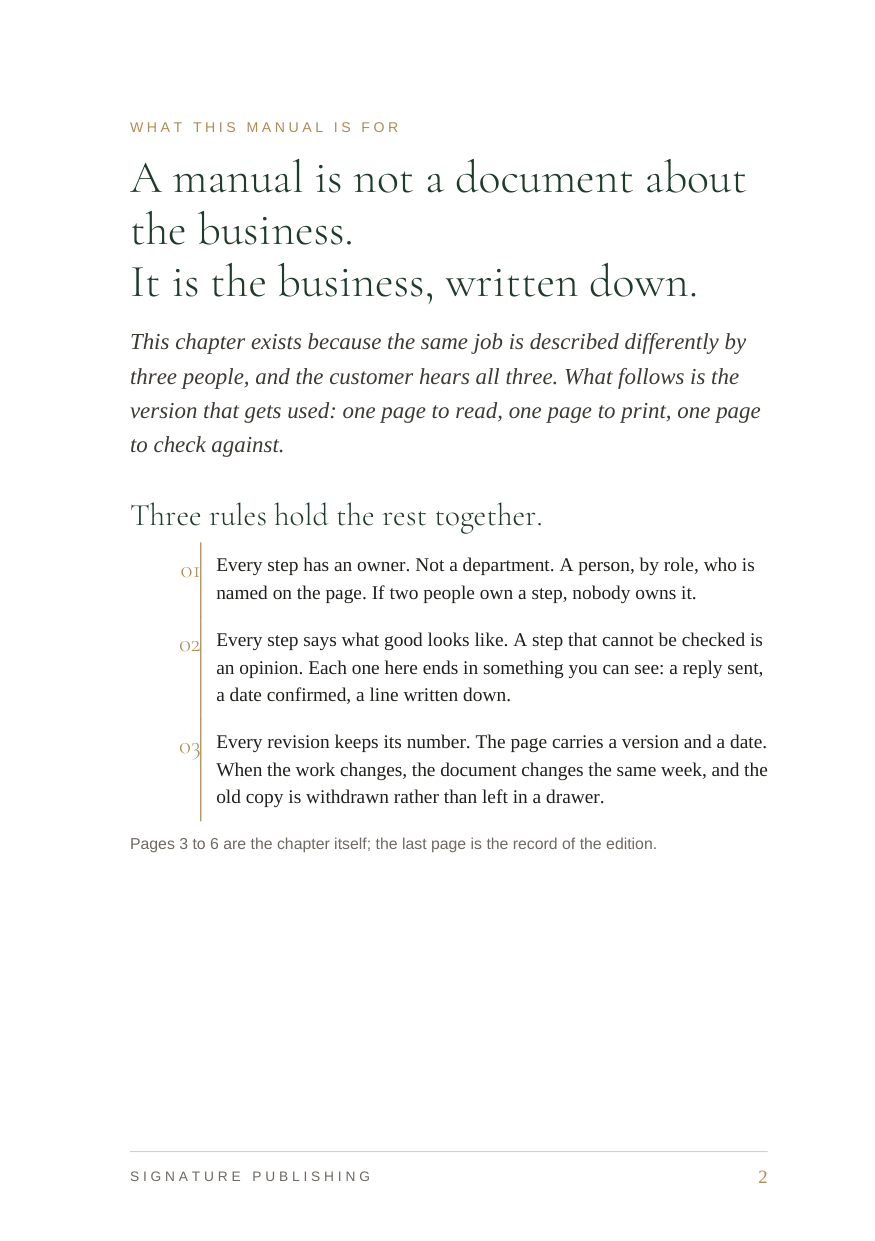
Specimen chapter, page 2: set in Cormorant Garamond and Liberation Serif, A5, seven pages, selectable text. Made here to fix the standard.

The cover of the same specimen. The full PDF is on this page, free to read.

One imprint, six kinds of book

Each line has a fixed format and a typical extent, so a quote can be written before the manuscript exists. The extents are ranges, not promises: the page count is fixed when the outline is approved.

  • 01Trade manuals

    How the work is done, step by step, with one owner per step and a page to print for the person doing the job. Written from interviews with the people who actually do it.

    A5 or US Letter · 24–60 pages · print PDF, screen PDF, one checklist per role
  • 02Business guides

    One decision per book: pricing, hiring, the first ninety days, what to stop selling. Short enough to read in an evening and specific enough to act on Monday.

    6 × 9 in · 40–90 pages · PDF and e-book, with one worksheet
  • 03Brand books

    The rules a brand is applied by: promise, voice, colour, type, what is allowed and what is not. For the company that has an identity and no single document holding it together.

    A4 · 20–48 pages · print PDF and screen PDF
  • 04Workbooks

    Exercises with space to write. Used in workshops, induction and coaching; designed to be printed single-sided and bound, or filled in on screen.

    A4 or US Letter · 20–40 pages · print PDF with binding margins, plus a fillable version
  • 05Client publications

    Annual reports, catalogues, commemorative books, campaign books — the long piece a client needs once and has no department for.

    Per piece · 12–64 pages · print PDF, screen PDF, e-book
  • 06Field guides

    Pocket references: the twelve checks before a job, the sizes we stock, the answers to the five questions customers always ask.

    4 × 6 in · 16–32 pages · print PDF, folded or stapled, plus a phone-sized PDF

Three readers, three problems

We do not sell “content”. Each line answers a situation the buyer recognises on reading it.

The owner of a business where the knowledge lives in one head

The problem
Everything stops when you take a week off. Every new hire learns by watching someone who is already overloaded, and what they learn leaves with them.
What you get
A manual a new employee can apply on the first day, and a checklist per role, so the answer is on the wall and not in your phone.
How you know it worked
Read it aloud to the person who does the job. If they can follow it without asking you a single question, it works.

The business whose documents contradict each other

The problem
Three price lists, two policies, an expired certificate and a form nobody remembers writing. Everyone uses the version they happen to have.
What you get
An audit of what exists, what expired and what contradicts what — then one documented set: a stable index, numbering that survives the next revision, and a change log.
How you know it worked
Every document carries a version, a date and an owner. The old ones are withdrawn, not left in a drawer.

The author or consultant with a manuscript and no production

The problem
The text is finished and it looks like a Word file. A print PDF, a cover and an e-book are three different jobs, and none of them is writing.
What you get
A manuscript turned into a print-ready PDF, an e-book and a cover that does not look self-published, with one original behind all three.
How you know it worked
It opens on a phone, the text can be selected, the cover survives a thumbnail, and the printed proof matches the screen.

Editorial work we take on for third parties

A single service or the whole chain. You can also arrive with the manuscript finished and ask only for production.

Service What the client receives What we need from you
Writing A finished draft in your voice, built from interviews, recordings and the documents you already have; structured, not transcribed. Delivered chapter by chapter for review. Two to four hours of interview time per chapter, access to the people who do the work, and one person who can approve.
Editing A structural report and a revised text: order, gaps, repetition, what to cut, what needs a source. Numbered comments so you can accept or reject each one. The full manuscript, the reader it is aimed at, and a decision on what the book is allowed to be.
Proofreading A clean text with tracked changes and a sheet of decisions: spelling variant, capitalisation, how figures are written — so the next document follows the same rules. The text in an editable file, your house style if you have one, and the names and figures you know to be correct.
Design & typesetting A print-ready PDF with a real grid: margins, running heads, page numbers, contents and consistent spacing — plus the editable source file. Measured, not eyeballed. The approved text, your logo and colours if the piece carries them, and your printer’s specification: trim size, bleed and binding.
Illustration Original diagrams, charts and line drawings made for the page they sit on, in one consistent style, delivered as vector files plus the versions each channel needs. What the drawing must explain, where every number in it comes from, and how much detail the reader can take.
PDF & e-book production A print PDF, a screen PDF and an e-book that share one text: selectable text, a contents page that works, images at the right resolution, no scanned pages. The final text and images, the rights for each image, and the platforms you intend to sell on.
Cover A cover designed for two sizes: full size on screen and a thumbnail the size of a stamp. Front, spine and back for print, plus the flat image the stores require. Title, subtitle, author or imprint, a short description of the book, and any image you hold the rights to.
Publishing & distribution A package your printer or platform accepts without a round of emails: print PDF, e-book, cover files, metadata (title, description, keywords, categories), and a checklist of what is left to decide. Your ISBN or the decision to use the platform’s, the account in your name, your payment details entered by you, and your approval of the final file.

What this is not: legal, tax or employment advice · purchase and registration of an ISBN · printing, stock and shipping · certified translation · rights clearance for images you supply · any guarantee of sales, reviews or search positions.

What a person still signs

Three decisions are not delegated, and they are the ones that decide whether a manual is used or filed.

The decision

What the piece is, and what it refuses to be

  • Who reads it, at what moment, and what they have to be able to do afterwards.
  • What stays out, even when it is true: the document that says everything is the one nobody uses.
The facts

The numbers, read and signed

  • The interviews with the people who do the work, and the version they recognise as their own.
  • Figures, dates and names checked against the source; no page leaves with a claim we cannot show.
The review

The last read, before it is printed

  • Open the PDF on a phone and on paper: selectable text, printed page numbers, measured margins, the checklist that gets printed and put on the wall.
  • Your lawyer or accountant decides what is legal, tax or employment; we write it the way you decide.

One rule for every piece we make: no page leaves with a claim we cannot show. Where a tool is used, the file records what produced each part, and a person signs the page.

The specimen, made here

A real manual chapter, produced with the tools on this machine. It is not a brochure about what we would do; it is the format you receive.

How the Work Is Done — chapter 02, Taking the job

Seven pages at A5: cover, imprint page, contents, chapter opener, the six steps of the procedure, the checklist to print, and the record of the edition.

Selectable text, embedded fonts, printed page numbers and measured margins. The checklist gets printed and put on the wall; the rest is read on a phone.

Open the PDF (7 pages)

Imprint · specimen

How the Work Is Done

A5 · 7 pages · English

What you can hire

Three ways in, each with a named deliverable. Prices are written per project, after the scope — none is invented on this page.

The document

Manual or procedure

One procedure cut to three pages — read, print, check — with the owner of each step named by role.

Fixed price · quoted in writing
The pair

Bilingual edition

The same document in English and Spanish, same layout, same version number, both checked line by line.

Fixed price · quoted in writing
The piece

Publication and typesetting

A book, a report or a specimen set and prepared for print, with the edition record on the last page.

Fixed price by scope

How to start

The same six steps for any piece. No work starts before step three exists in writing.

  1. The brief. One page: what the piece is, who reads it, in which language, by when, and what already exists.
  2. Outline and specimen. The contents and one written section, so the voice is agreed before the rest is written.
  3. Fixed quote. Scope, extent, dates and price in writing, before any work starts. No hourly surprises.
  4. Approval. You approve the outline and the specimen; anything that changes afterwards is quoted as a change.
  5. Production in versions. Each chapter is reviewed by the person who will use it. Two rounds of corrections per stage, included.
  6. Check and handover. A second read, the measurements (pages, margins, embedded fonts, selectable text), and the files in the formats you asked for.

In your first message, say what the document is, who reads it, in which language, when you need it and whether a manuscript exists. You get an outline and a written quote before you pay anything.